If you are missing one tooth, an implant or a bridge is usually the conversation. If you are missing most or all of your teeth, dentures or All-on-4 come into play. The right choice comes down to how many teeth you are replacing, how much your jawbone has changed, how the option feels day to day, and how long you want the result to last. A straight comparison of all four follows so you can see where you fit.
The four main options at a glance
Each of these solves a different version of the same problem. A quick overview first, then we get into the detail. If some of your own teeth might still be restored, choosing between saving your teeth and getting dentures comes before this comparison.
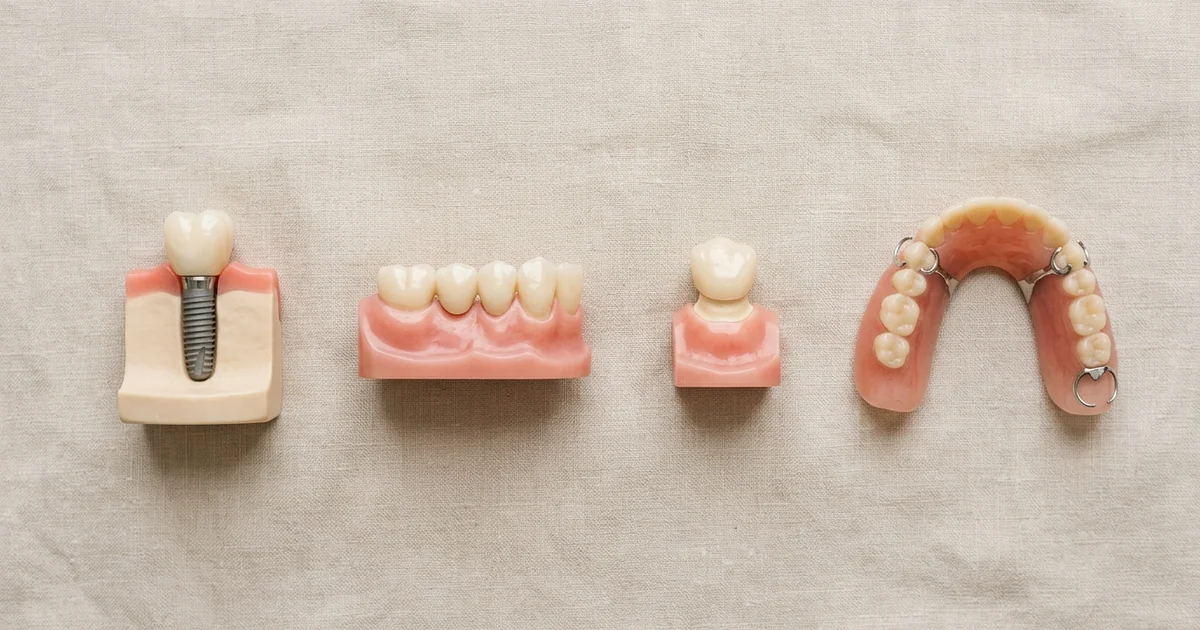
- Dental implant. A titanium post in the jaw with a crown on top. Best for one or a few missing teeth. The longest-lasting option, and the closest thing to a natural tooth.
- Dental bridge. A false tooth held by crowns on the neighboring teeth. No surgery, faster to complete, but it leans on the teeth beside the gap.
- Dentures. A removable set of teeth. Replaces many teeth at once, but they can move and they do not stop bone loss.
- All-on-4. Four implants holding a full fixed arch. For replacing a whole row of teeth. Fixed in place, often done in a day.
| Option | Best for | Surgery? | Typical lifespan | Protects jawbone? |
|---|---|---|---|---|
| Dental implant | One or a few missing teeth | Yes | Decades, often a lifetime | Yes |
| Dental bridge | One missing tooth, no surgery | No | Ten to fifteen years | No |
| Dentures | Many missing teeth, removable | No | Relined and replaced over time | No |
| All-on-4 | A full row of teeth, fixed | Yes | Decades with good care | Yes |
How long each one lasts
This is where implants pull ahead. An implant can last decades, often a lifetime, with good care. A bridge usually lasts ten to fifteen years before it needs replacing. Dentures need relining and replacing over the years as your mouth changes shape. All-on-4 gives you the durability of implants for a full arch. When you are deciding, it helps to think about how long the result will hold up, not just how it feels on day one. Our guide to the benefits of dental implants and our All-on-4 guide go deeper on each.
Dentures have a working life of their own, and we cover how long dentures last before they wear out in a separate post.
What each does to your jawbone
Where each option leaves your jawbone is the difference that matters most over time. When you lose a tooth, the bone underneath starts to shrink because nothing is stimulating it anymore. Implants and All-on-4 fuse with the bone and keep it active, which preserves it and helps maintain the shape of your face. Bridges and dentures sit on top of the gum and do not stop that bone loss. Over years, that is why long-time denture wearers can see their facial structure change. Our post on how gum disease affects bone touches on why bone matters.
Surgery and timeline
Bridges and dentures do not require surgery, so they are faster and easier if you want to avoid a procedure. Implants and All-on-4 involve oral surgery and a healing period while the implant fuses with the bone, which takes a few months. For some patients that wait is worth it. For others, getting there quickly matters more. There is no wrong answer, just trade-offs. If implants appeal, our guide to choosing between snap-in and fixed implant teeth compares the two ways they can carry a full arch.
A simple way to narrow it down
- Missing one tooth and want it to last? An implant is usually the best long-term choice.
- Missing one tooth and want to avoid surgery? A bridge is a solid option.
- Missing most or all teeth and want something fixed in place? All-on-4 is worth a serious look.
- Missing most or all teeth and want a removable option? Dentures replace a full row at once.
Bring the gap in and we'll narrow it down
A bridge, an implant, dentures, All-on-4: the smart pick depends on things a chart can't tell you, like how much bone you still have and how the teeth bordering the gap are holding up. Read how the four stack up on our dental implants page, alongside the pages on a single tooth implant and on dental bridges, but don't try to settle it from an article alone. Once Dr. Estrada sees your mouth in person, the choice usually makes itself, and we'll walk through it together, in English or Spanish. Call (727) 869-3886 or reach us through the contact page.
Frequently Asked Questions
Which tooth replacement lasts the longest?
Dental implants pull ahead here. An implant can last decades, often a lifetime, with good care. A bridge usually lasts ten to fifteen years, and dentures need relining and replacing over time as your mouth changes shape.
Which options protect my jawbone?
Implants and All-on-4 fuse with the bone and keep it active, which preserves it and helps maintain your facial shape. Bridges and dentures sit on top of the gum and do not stop the bone loss that follows tooth loss.
Which option avoids surgery?
Bridges and dentures do not require surgery, so they are faster and easier if you want to avoid a procedure. Implants and All-on-4 involve oral surgery and a healing period while the implant fuses with the bone. There is no wrong answer, just trade-offs.
How do I know which one is right for me?
The best option depends on details only an exam can reveal, like how much healthy bone you have and the condition of the teeth around a gap. Once Dr. Estrada can see all of that, the comparison between implants, a bridge, and dentures gets much clearer.