For a single missing tooth, a bridge is faster and avoids surgery but requires grinding down the two neighboring teeth and does not stop bone loss in the gap. An implant stands on its own, preserves the jawbone, and tends to last longer, though it takes more time and needs adequate bone. The right choice depends on your neighboring teeth, your bone, your timeline, and your budget.
Both can look natural and restore your bite. The differences are mostly about what each one asks of the rest of your mouth. The right call depends on those neighboring teeth and how long you want the result to last.
| Factor | Dental bridge | Single-tooth implant |
|---|---|---|
| Neighboring teeth | Two are ground down to hold crowns | Left untouched |
| Surgery | None | Minor surgery to place the post |
| Timeline | A couple of visits over a few weeks | Several months to fuse, then the crown |
| Jawbone | Does not stop bone loss in the gap | Replaces the root and preserves bone |
| Typical lifespan | Ten to fifteen years | Often decades with good care |
How does a dental bridge work?
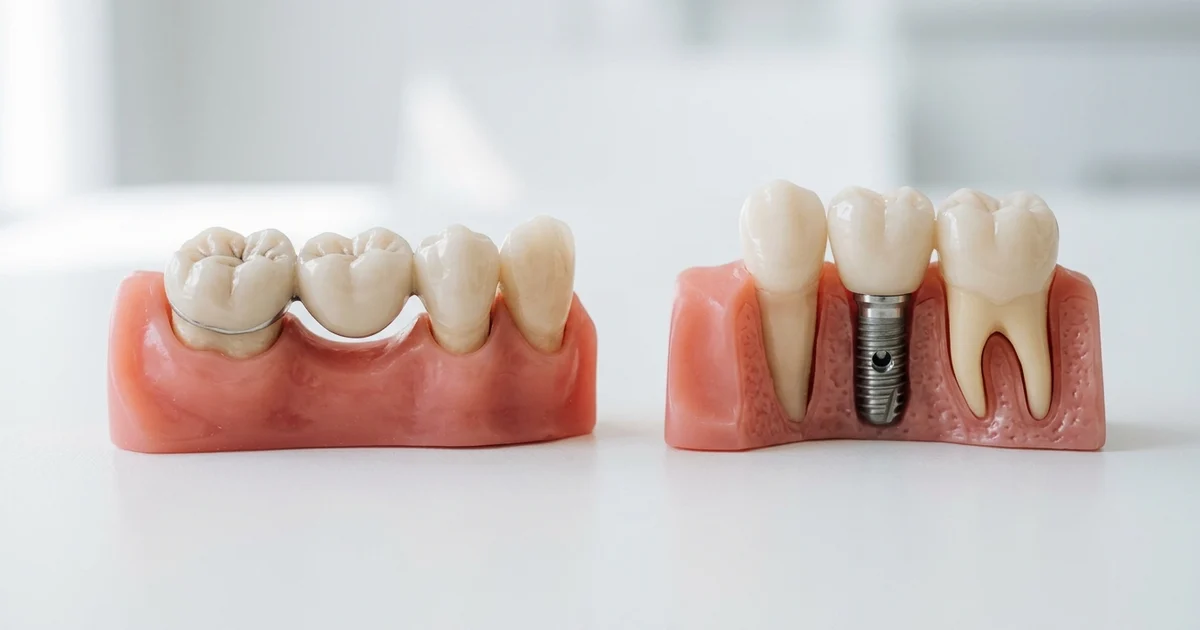
A dental bridge fills the gap with an artificial tooth that is anchored to crowns on the two neighboring teeth. Those neighbors are reshaped to hold the crowns, and the whole bridge is cemented in as one connected piece.
The big advantage is speed. A bridge usually takes just a couple of visits over a few weeks, with no surgery and no healing period for bone.
The trade-off is that two otherwise healthy teeth get permanently ground down to support the bridge. If those teeth are already crowned or heavily filled, that matters less. If they are pristine, it is a real cost to weigh.
How is a single-tooth implant different?
A single-tooth implant replaces just the missing tooth with a titanium post placed in the jaw, topped by a crown, without touching the neighboring teeth. It stands completely on its own.
Because nothing else is altered, your healthy adjacent teeth stay whole. The implant also acts like a tooth root, which keeps the jawbone stimulated. Our guide on the benefits of dental implants covers this in detail.
The cost is time and a minor surgery. The post needs months to fuse with the bone before the crown goes on, and you need enough healthy bone to start. Our dental implants page explains the process step by step.
Why does bone loss in the gap matter?
When a tooth is missing, the jawbone underneath the gap slowly shrinks because nothing is stimulating it, and a bridge does not stop this. An implant does, because the post replaces the root and keeps the bone active. This is one of the biggest differences between the two.
Over years, bone loss under a bridge can create a visible gap beneath the artificial tooth and change how that area looks. It can also make future treatment harder.
If you want the full picture of why an empty space is not harmless, read what happens if you do not replace a missing tooth. Bone preservation is often what tips people toward an implant.
Which lasts longer, and which is faster?
Implants tend to last longest, with dental literature often citing survival rates around 95 percent over ten years, while bridges commonly last around ten to fifteen years before needing replacement. Bridges, however, are the faster route to a filled gap. So you are trading time now against longevity later.
A bridge gets you a complete smile in weeks. An implant can take several months from start to finish but often serves you for decades with good care. If the tooth is still in place, our post on the wait between an extraction and an implant shows where those months go.
Neither is guaranteed, and individual results vary with your habits and health. Daily home care and cleanings strongly influence how long either option lasts.
How do I decide between them?
Weigh four things: the health of your neighboring teeth, the amount of bone in the gap, how quickly you want the gap closed, and your budget. If the neighbors are already crowned and you want a faster solution, a bridge may make sense. If they are healthy and you want bone preserved, an implant often wins.
Your overall health, smoking, and bone quality all factor in too. A consultation with imaging is the only way to know which you actually qualify for.
If cost is a concern, options like CareCredit can help spread payments. For a broader look at every choice, see our guide comparing tooth replacement options.
One gap, two good options, one right fit for you
A bridge leans on the teeth beside the gap. An implant stands on its own and leaves those neighbors untouched. Which one suits you depends on the health of the teeth around the space, your bone, and how you'd rather spend your time and budget. We'll lay out the honest trade-offs for your specific mouth, no pressure either way. Look at our dental implants options, then call (727) 869-3886 or use the contact page to talk it over.
Frequently Asked Questions
Is an implant or a bridge better for one missing tooth?
It depends on your situation. An implant stands alone, preserves bone, and tends to last longer, making it ideal when neighboring teeth are healthy. A bridge is faster and avoids surgery but grinds down two neighbors and does not stop bone loss. A consultation with imaging helps confirm which suits you.
Does a bridge really damage the neighboring teeth?
A traditional bridge requires reshaping the two teeth beside the gap so they can hold supporting crowns. This permanently removes healthy enamel from them. If those teeth already have crowns or large fillings, the impact is smaller. If they are pristine, that loss is a real factor to weigh against an implant.
How long does a single-tooth implant take?
Start to finish, a single implant often takes several months because the titanium post needs time to fuse with the jawbone before the crown is attached. A bridge is faster, usually a couple of visits over a few weeks. You trade a longer timeline for an implant that can last decades.
Why does a missing tooth cause bone loss?
The jawbone needs stimulation from a tooth root to stay strong. When a tooth is gone, the bone in that gap slowly shrinks because nothing replaces that stimulation. A bridge sits above the gap and does not stop this, while an implant acts like a root and keeps the bone active.