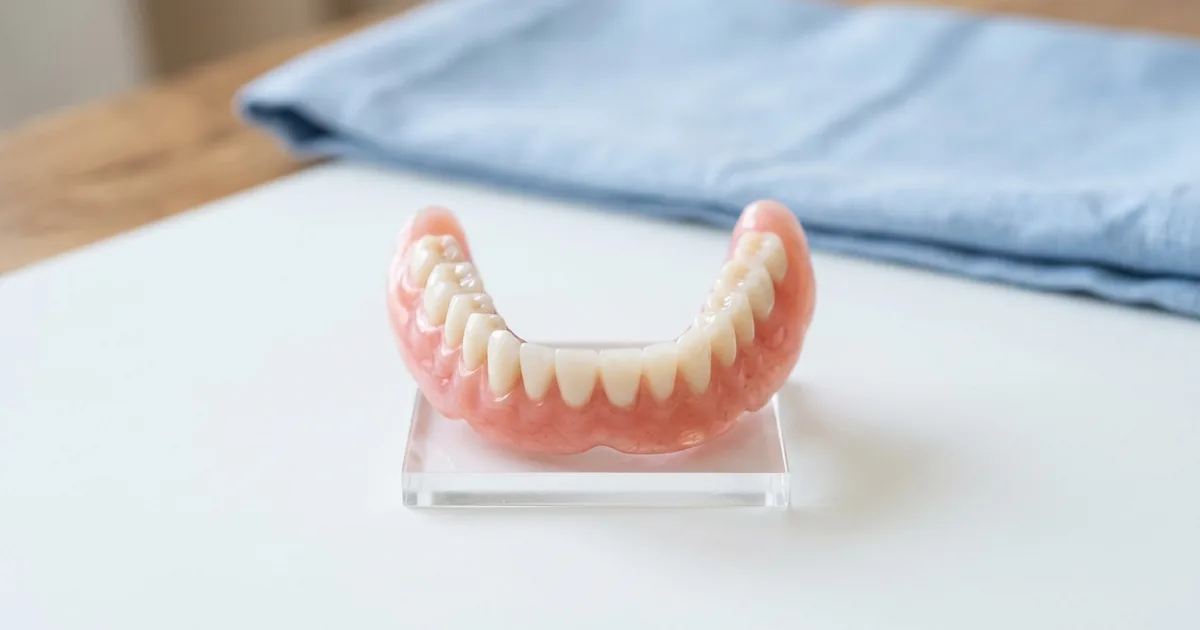
A lower denture floats because the lower jaw gives it much less to hold onto than the upper. It has a narrow ridge, no palate to create suction, and a tongue and cheek muscles that move every time you talk or swallow. It is one of the most common denture complaints, and it comes from anatomy, not from a badly made denture. The fixes run from a simple adjustment to a lower held by two implants, and most people stop at the first step that solves it.
Why won't a lower denture stay in like the upper?
An upper denture sits on a broad, bony palate and seals against it, so swallowing pulls it tighter, and that same palate coverage is why an upper denture can make you gag. A lower denture is a horseshoe resting on a thin ridge with the tongue inside it and the cheeks outside, and both are muscles that never stop moving. So full dentures on the top feel secure within weeks, while the bottom can feel loose for years. The table sets the two side by side.
| Factor | Upper | Lower |
|---|---|---|
| Surface area | Large: the whole palate plus the ridge | Small: a narrow horseshoe of ridge |
| Suction | A seal across the palate holds it | No palate, so almost no seal |
| Muscle movement | Cheeks and lips only | Tongue inside, cheeks outside. Floor of the mouth rises on every swallow. |
| Ridge shape | Broad and stable | Thinner, and it shrinks further over the years |
| How it is held | Fit and suction | Fit, muscle control, a thin layer of adhesive, or implants |
What makes a lower denture float more over time?
The ridge under a lower denture slowly shrinks once the natural teeth are gone, so a denture that fit at 65 can rock at 75 without anything being wrong with the denture itself. Less saliva makes it worse, because saliva is part of what holds a denture against the gum, and many medications taken later in life dry the mouth. Our guide to dry mouth in older adults explains why.
Weight loss changes the fit as well. Sudden looseness with rapid weight loss or a new medication is worth mentioning to the physician too. A denture that has loosened because the ridge changed shape is usually a job for denture relines.
Is it my technique?
Sometimes, and it is the simplest thing to check. Seat the lower with your fingers, then rest the tongue forward so its tip sits lightly against the back of the lower front teeth. A tongue that pulls back lifts the denture. Take small bites and chew on both sides at once, which keeps the horseshoe level. Swallow before you speak.
If the denture is only a few weeks old, some looseness is the normal settling period, and our guide to getting used to new dentures week by week covers what to practice. If you have worn lowers for years and the floating is new, technique is rarely the cause.
Does adhesive fix it?
A thin layer can help a well-fitting lower stay put through a meal. The American Dental Association's MouthHealthy guidance says the same, that adhesive can add security to a denture that already fits but is no fix for one that does not. Use the smallest amount that works and clean it off fully each night. Any brand will do. They all work about the same way.
Needing more and more adhesive to get through the day is a sign to come in, because the fit has changed and adhesive cannot change it back.
What are the fixes, from simplest to most stable?
We try these in order.
- Adjustment. A denture that rocks on one spot or digs in at the edge can often be settled with a small adjustment in the office, often in the same visit.
- Reline. When the ridge has shrunk and the denture no longer matches it, a reline adds new material to the fitting surface so it hugs the gum again. The reline page covers what is involved and how often it is usually needed.
- A new denture. Sometimes the base has thinned, the teeth have worn flat, or the denture has been relined more than once. A new one made to the current shape of the ridge then usually holds better than another reline.
- Two implants with a snap-in lower. This is the only fix that changes what holds the denture in. Two implants placed in the front of the lower jaw give the denture something to clip onto, so it no longer depends on a ridge that gives it little to hold. In 2002 an international group of dental specialists meeting at McGill University in Montreal issued a consensus statement naming a lower denture held by two implants the first-choice standard of care for a lower jaw with no teeth. Dr. Estrada has decades of implant work behind him. Our implant supported dentures page explains the attachments. Whether your current denture can be fitted with them or a new one is made is decided at the exam.
Implants add more stability to a denture you already wear. For anyone weighing the full range, same day teeth compared with traditional dentures describes the fixed option, and how implants restore chewing and stability explains what the implants do. Our post on dental implants after bone loss answers the question most long-term denture wearers ask first.
When should I come in rather than adapt?
Come in if the denture drops when you laugh or yawn, clicks when you speak, lets food under it at every meal, or leaves sore spots that keep returning in the same place. Each of those is a fit problem with a fix on the list above, and more adhesive will not solve any of them. A short visit tells you which step you are on. For the sore itself, the post on which denture sore spots need a visit walks through what to do before you come in.
Have the fit checked
The lower jaw was never going to hold a denture the way the palate holds an upper, and many wearers put up with a floating lower for years when a short visit could settle it. Call (727) 869-3886 or use our contact page to have the fit checked, and we will tell you which step is the right one. This article is general information, not a diagnosis. Dr. Estrada decides which step your denture needs at the exam.
Frequently Asked Questions
Why does my lower denture lift when I eat or laugh?
Laughing and chewing move the tongue, cheeks and the floor of the mouth, and a lower denture sits right in the middle of all three with no suction to hold it. If the ridge has shrunk since the denture was made, there is even less to grip. A fit check shows whether an adjustment or reline will settle it or whether the ridge now gives a denture alone too little to grip.
Can a lower denture ever fit as tightly as an upper?
Not by suction alone, because there is no palate to seal against. A well-made lower on a healthy ridge can be comfortable and stable for everyday eating, and a lower clipped onto two implants can feel as secure as most uppers. The gap between the two is why implants are the common answer for a lower that will not settle.
How many implants does it take to hold a lower denture?
Usually two, placed in the front of the lower jaw where the bone is usually thickest and densest, with the denture snapping onto them. More can be used for a fixed set of teeth, which is a different conversation. The number is decided at the exam from your bone and what you want the denture to do.
Will a new lower denture stay in better than my old one?
Often, if the old one was made for a ridge that has since changed shape or its base has thinned. A new lower is made to the current shape of your jaw and can be designed with the muscles in mind. It still has the same anatomy to contend with, so if the ridge is very flat, two implants may be the better step and we will say so before anything is made.